Short answer:
5G RedCap (Reduced Capability) is a streamlined version of 5G designed for IoT and industrial devices that need reliable connectivity without the cost, power draw, or complexity of full 5G. It sits between LTE and full 5G, using 5G networks while simplifying hardware requirements.
5G RedCap is designed to address the gap between low-power cellular technologies such as LTE-M and the high performance, cost, and complexity of full 5G NR. It focuses on predictable performance, simpler radio design, and long-term deployment stability for connected devices.
Where 5G RedCap fits in the connectivity landscape
5G RedCap occupies a specific position between low-power wide-area technologies and full 5G. It is not designed to replace either, but to address applications that fall between them.
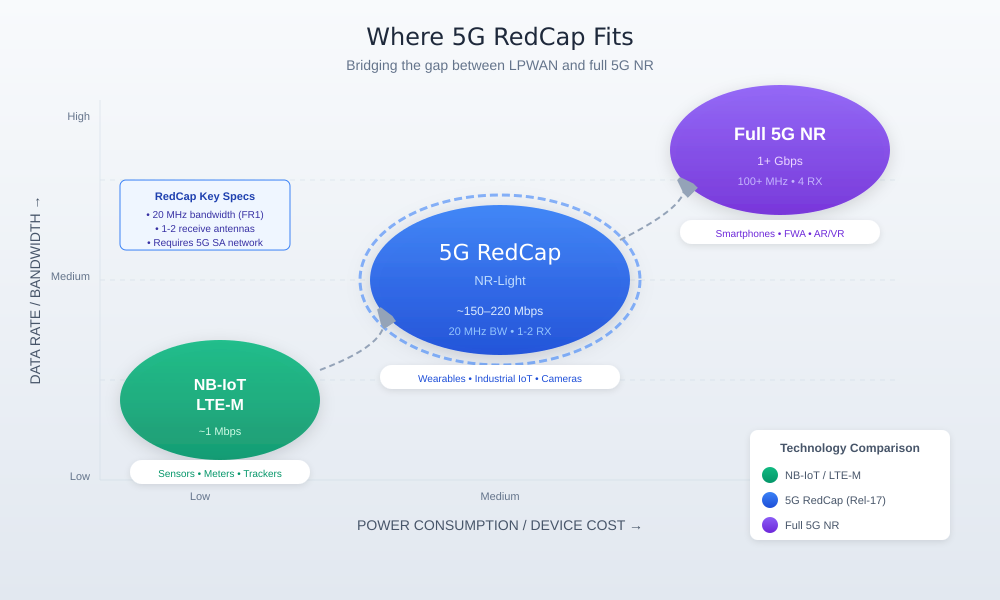
Connectivity comparison
| Technology | Power Consumption | Device Cost | Typical Speed | Primary Use |
|---|---|---|---|---|
| NB-IoT / LTE-M | Very low | Very low | Low | Sensors, meters, basic tracking |
| 5G RedCap | Low | Medium | Medium | Wearables, mid-tier IoT, industrial devices |
| Full 5G NR | High | High | Very high | Smartphones, broadband, AR/VR |
5G RedCap provides a balance of performance and efficiency that neither LTE-M nor full 5G is designed to deliver.
How 5G RedCap differs from LTE-M and full 5G
5G RedCap is defined in 3GPP Release 17 as a reduced-capability 5G device category. In 3GPP terminology, it may also be referred to as NR-Light, but “RedCap” is the commonly used industry term.
RedCap vs LTE-M vs full 5G
| Feature | LTE-M | 5G RedCap | Full 5G NR |
|---|---|---|---|
| Network generation | 4G LTE | 5G | 5G |
| Core network | LTE core | 5G core | 5G core |
| Latency | Moderate | Lower | Lowest |
| Peak data rate | Low | Medium | Very high |
| Power efficiency | Excellent | Good | Poor |
| Hardware complexity | Very low | Reduced | High |
| Intended devices | Simple IoT | Mid-tier IoT | Consumer & broadband |
RedCap deliberately trades peak throughput and radio complexity for lower power use and reduced device cost, while still benefiting from 5G architecture.
Technical characteristics of 5G RedCap
Typical technical characteristics of 5G RedCap devices include:
- Reduced channel bandwidth compared to full 5G
- Fewer RF chains and antennas
- Simplified modem design
- Lower peak throughput than full 5G
- Improved power efficiency compared to full 5G devices
- Compatibility with 5G core features such as lower latency operation
Exact performance depends on chipset, spectrum band, network configuration, and operator support.
5G RedCap and IoT / M2M connectivity
5G RedCap is primarily targeted at mid-tier IoT and M2M devices that sit between simple sensors and high-bandwidth consumer equipment.
Typical RedCap-oriented device classes include:
- Wearables and health monitoring devices
- Industrial monitoring and control equipment
- Asset tracking with richer telemetry
- Smart city infrastructure components
- Connected consumer devices where battery life is critical
These applications benefit from improved responsiveness and data capability without the power and cost penalties of full 5G hardware.
5G RedCap and UK mobile networks
In the UK, 5G RedCap availability is closely linked to the rollout of 5G Standalone (SA) core networks.
While many UK networks already offer 5G coverage, much of this is delivered using Non-Standalone (NSA) architecture, which limits RedCap support. For RedCap to operate as intended, operators must support:
- 5G Standalone core networks
- RedCap device profiles
- Appropriate scheduling and spectrum configuration
As a result, RedCap support may vary by operator, region, and deployment phase, even where 5G coverage exists.
When 5G RedCap makes sense — and when it does not
5G RedCap makes sense when:
- Battery life is important but ultra-low power is not required
- Moderate data rates are sufficient
- Device cost must be controlled
- Access to 5G core features is beneficial
5G RedCap does not make sense when:
- Ultra-low power operation is required (NB-IoT or LTE-M is more suitable)
- Very high throughput is needed (full 5G is required)
- 5G Standalone network support is not available
Understanding these boundaries is essential to selecting the correct connectivity technology.
Frequently asked questions about 5G RedCap
Does 5G RedCap require 5G Standalone?
In practice, yes. RedCap is designed to operate with 5G Standalone core networks.
Is 5G RedCap faster than LTE-M?
Yes. RedCap typically supports higher data rates and lower latency than LTE-M.
Is 5G RedCap a replacement for full 5G?
No. RedCap is a reduced-capability profile intended for different device classes.
Can 5G RedCap be used for video?
It may support limited video use cases, but it is not designed for high-bandwidth streaming.