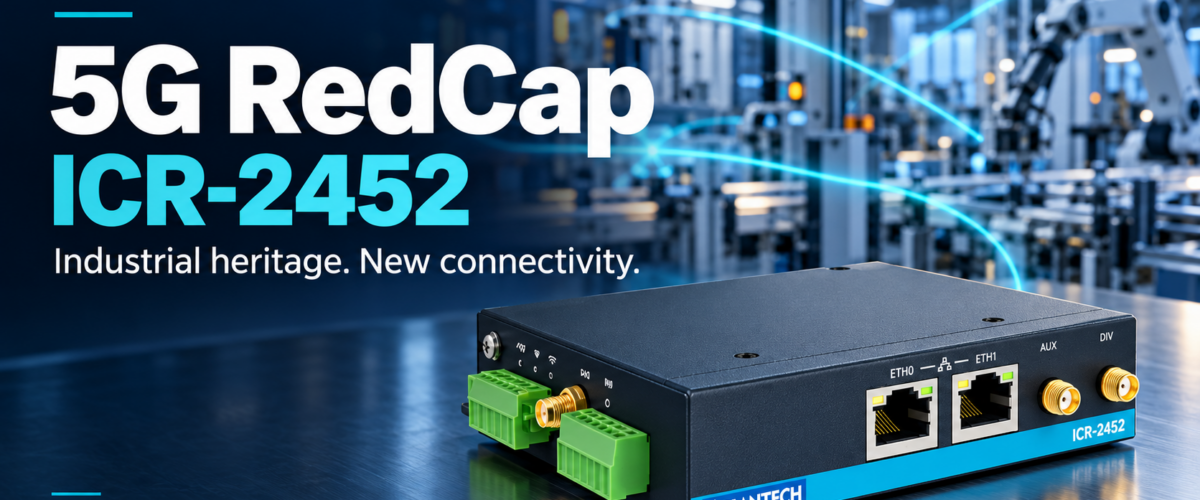
Advantech has spent three decades selling compact, dependable LTE routers into substations, pumping stations and roadside cabinets. RedCap is the first 5G technology aimed squarely at that market, and the ICR-2452 is Advantech’s answer to it. Here is who Advantech are, why RedCap matters to their customers, and a detailed look at what the ICR-2452 does well and where it falls short.
The manufacturer
Who are Advantech?
Most people in industrial IT know Advantech as the Taiwanese giant behind industrial PCs, embedded boards and automation kit. Fewer realise that its cellular router range has Czech roots that predate the Advantech name by decades.
The routers are designed and built in Ústí nad Orlicí, in the east of the Czech Republic, by the business that was originally Conel s.r.o. Conel was founded in 1991 and built a reputation for small, rugged GPRS, EDGE and UMTS routers that just kept working. In March 2012 it was bought by the American firm B&B Electronics, which later became B+B SmartWorx, and that business was in turn absorbed into Advantech. The Czech team kept designing the products, and today trades as Advantech Czech s.r.o.
That lineage explains a lot about the product range. The ICR family runs a Linux-based firmware, now called ICR-OS, which grew out of the Conel platform. Advantech supports it with a library of add-on “Router Apps” and a cloud fleet management service called WebAccess/DMP. The customer base leans heavily towards energy distribution, water, gas, traffic management and other utility work, where a router may sit in a cabinet for ten years without anyone touching it.
- 1991Conel founded in the Czech Republic, building cellular modems and routers.
- 2012B&B Electronics acquires Conel, giving the routers global distribution.
- 2016B+B SmartWorx becomes part of Advantech; the Czech operation continues as Advantech Czech.
- Nov 2025Advantech announces the ICR-2452, its first RedCap router.
The market shift
Why RedCap changes Advantech’s target market
For most of the last decade, the industrial cellular router market has had a clear split. At the bottom sit LTE Cat 1 and Cat 4 routers: cheap, low power and plenty fast enough for SCADA polling, telemetry, CCTV snapshots and remote access. At the top sit full 5G routers with large, power-hungry modules, aimed at video, backhaul and high-throughput sites. Advantech’s ICR-2000 series has lived firmly in the first group, and that is where most of its volume comes from.
The problem for the bottom tier is longevity. Utilities and infrastructure operators buy on ten to fifteen year lifecycles. Anyone who lived through the 3G switch-off, or who is watching 2G wind down, knows how expensive it is when a network technology leaves before the hardware does. LTE is not going anywhere soon, but a buyer specifying a router for a 2026 substation project now has to ask whether a Cat 4 device is the right bet for 2040.
Full 5G has never been a good answer to that question for this market. The modules are expensive, the power budget is high, and the throughput is wasted on a site that sends a few megabytes of Modbus data a day. RedCap closes that gap. It is a slimmed-down version of 5G NR, introduced in 3GPP Release 17, designed for exactly this kind of device: modest bandwidth, lower cost and lower power, but running on the 5G Standalone core with its longer runway and features such as network slicing.
That puts RedCap directly in Advantech’s core market rather than at its premium edge. The company’s existing customers are the ones most likely to be asked, over the next few years, for “5G-ready” hardware on tenders, and RedCap is the most credible way to meet that requirement without changing the cost and power envelope of a typical utility deployment.
The response
How Advantech has responded
Advantech’s approach has been to split its 5G portfolio by job rather than by generation. Full 5G stays in the higher-end ICR-4000 series, including the ICR-4172 and ICR-4272, for sites that genuinely need the bandwidth. RedCap goes into the entry-level ICR-2000 series, in the same compact metal chassis, terminal-block connectors and software stack that existing customers already deploy in volume.
ICR-2000 series: entry level
Compact DIN or wall-mount routers for telemetry, SCADA and remote access. Historically LTE Cat 1 and Cat 4. The ICR-2452 brings RedCap into this range as the 5G option for low and mid-range data sites.
ICR-4000 series: full 5G
Larger, higher-performance routers such as the ICR-4172 and ICR-4272, for sites where throughput really matters: video, aggregation points and primary links for bigger installations.
The sensible part of this strategy is continuity. An integrator who already has a fleet of ICR-2000 routers managed through WebAccess/DMP can introduce the ICR-2452 without retraining staff, rewriting configuration templates or changing the cabinet layout. The connectors, the firmware, the Router Apps and the management platform are all familiar. For a utility customer, that matters as much as the radio.
In-depth review
Advantech ICR-2452 RedCap: the hardware
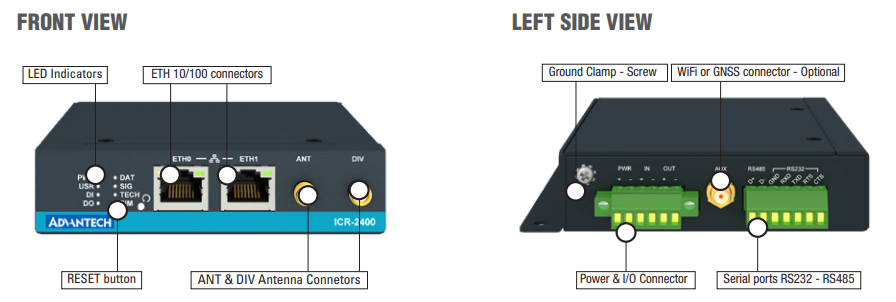
The ICR-2452 is a small metal box measuring 103 x 95 x 25 mm and weighing around 350 g. It has a grounding screw, an IP30 rating and ships with a wall-mount kit, with a DIN rail clip available as an accessory. In short, it is built to be bolted into a cabinet and forgotten about.
| Specification | ICR-2452 |
|---|---|
| Cellular | 5G RedCap (Standalone) with LTE fallback |
| 5G peak speed | 223 Mbps down, 123 Mbps up |
| LTE peak speed | 150 Mbps down, 50 Mbps up |
| 5G SA bands | n1, n2, n3, n5, n7, n8, n12, n13, n14, n18, n20, n25, n26, n28, n30, n38, n40, n41, n48, n66, n70, n71, n77, n78, n79 |
| LTE bands | FDD B1, B2, B3, B4, B5, B7, B8, B12, B13, B14, B17, B18, B19, B20, B25, B26, B28, B30, B66, B71. TDD B34, B38, B39, B40, B41, B42, B43, B48 |
| Antennas | 2 x SMA (main and diversity) |
| SIM | 2 x Micro SIM (3FF), behind a cover |
| Ethernet | 2 x RJ45, 10/100 Mbps, each configurable as LAN or WAN |
| Serial | 1 x RS232, 1 x RS485 on a 7-pin terminal block |
| I/O | 1 x digital input, 1 x digital output (open drain, 48 V / 100 mA) |
| Processor and memory | ARM926EJ-S at 600 MHz, 128 MB RAM, 64 MB flash |
| Power | 9 to 48 V DC, roughly 2.1 W idle, 2.5 W average, 3.4 to 3.7 W maximum |
| Temperature | -40 to +75 °C operating |
| Approvals | CE, UKCA, EN 18031-1 cybersecurity, EN 62368-1 safety |
Two variants: GNSS or Wi-Fi
ICR-2452G
Adds a passive GNSS receiver (GPS, GLONASS, BeiDou, Galileo and NavIC) on an extra SMA connector. Useful for timestamping, asset location and anything mobile.
ICR-2452W
Adds dual-band Wi-Fi on an R-SMA connector, with access point (up to 8 clients), client and combined modes. Handy for engineer access on site.
You get one or the other, not both. Both variants are listed for the EMEA region only, so this is a European and UK product rather than a global one.
The radio
The headline figures of 223 Mbps down and 123 Mbps up are in line with what a Release 17 RedCap device with two receive antennas can achieve on a 20 MHz carrier. In practice, real-world RedCap speeds will be lower and will depend heavily on the cell, but for a telemetry router that is beside the point. The important number is the uplink, and 123 Mbps peak is more than enough for CCTV clips, log uploads and firmware pushes.
The band list is generous. All the bands that matter in the UK are covered, including n78 for most operators’ 5G and n28 and n1 for wider-area coverage, plus a full LTE set. Advantech does not name the cellular module in the datasheet, which is a minor irritation for anyone who likes to cross-check firmware and carrier approvals.
The critical point for UK buyers is that RedCap only works on 5G Standalone. The ICR-2452 will not use RedCap on a Non-Standalone network, which is still how a lot of UK 5G is delivered. Where SA is not available, the router falls back to LTE, and its LTE performance (150 down, 50 up) is roughly Cat 4 class. That fallback is not a weakness so much as the whole design: you get an LTE router today that becomes a 5G router as SA coverage arrives, without a site visit.
Interfaces
The interface set is classic Conel and exactly what a utility engineer wants: two Ethernet ports that can each be LAN or WAN, RS232 and RS485 on screw terminals, and a digital input and output that share the power connector. The RS485 port alone makes this a direct replacement for a lot of ageing serial-modem installations.
The dual SIM slots take Micro SIMs behind a screwed cover, which is good for tamper resistance. There is no mention of eSIM or eUICC support, which is a missed opportunity for a product sold on future-proofing. As SGP.32 rolls out, the ability to change network profiles remotely will become a real selling point for fleets deployed on long lifecycles.
Software
This is where Advantech is strongest. ICR-OS supplies the usual routing set (DHCP, NAT, VLAN, QoS, VRRP and IPv6 dual stack) along with WireGuard, OpenVPN, IPsec with IKEv2, GRE and L2TP. Authentication via RADIUS and TACACS+ and two-factor login are included out of the box.
The Router Apps extend it into proper industrial territory: Modbus RTU/TCP gateway, DNP3, IEC 60870-5-101 to 104 conversion, DF1, MQTT and LwM2M, plus dynamic routing with BGP, OSPF and DMVPN. IEC 104 and DNP3 support tell you exactly who this router is for. Open Linux with Python, BASH and C/C++ means integrators can run their own code on the box.
The event engine can trigger SMS, email or SNMP alerts from the digital input, data usage or connection status, and WebAccess/DMP handles fleet provisioning, firmware updates and VPN management centrally.
Power and environment
An average draw of around 2.5 W on a 9 to 48 V supply is excellent for a 5G device and confirms RedCap’s main promise. That figure makes solar and battery-backed sites practical, and the wide input range means it can run straight off a 12 V or 24 V cabinet supply. The -40 to +75 °C operating range covers unheated outdoor enclosures across the UK and Europe.
Certification
One detail worth highlighting is EN 18031-1. This is the cybersecurity standard linked to the EU Radio Equipment Directive’s security requirements, which apply to internet-connected radio equipment sold in the EU. Seeing it listed on the datasheet, alongside UKCA, is reassuring for anyone buying for critical infrastructure.
Worth knowing
Where the ICR-2452 falls short
10/100 Ethernet
Both Ethernet ports are Fast Ethernet. That caps wired throughput at under 100 Mbps, below the RedCap peak. For telemetry it will never matter, but anyone planning to use this as a high-speed primary link should be aware of it.
Processor headroom
The ARM926EJ-S is an older, single-core design. It is proven and efficient, but encrypted VPN throughput is likely to be limited by the CPU well before the radio. Test it with your real VPN configuration before relying on it for bulk traffic.
Standalone dependency
No SA coverage means no RedCap. Check your operator’s SA footprint at each site, and treat LTE as the working assumption until it is confirmed.
Datasheet tidy-up
The feature list says Wi-Fi 802.11n while the spec table says 802.11ac, and the LED legend mentions 2G and 3G even though the band list covers only LTE and 5G. Small things, but worth clarifying with Advantech when ordering.
Verdict
Is the Advantech ICR-2452 worth it?
The ICR-2452 is not trying to be a fast 5G router, and it should not be judged as one. It is an entry-level industrial router that happens to have a 5G radio, and it is very good at that job. The low power draw, terminal-block serial and I/O, industrial protocol support and Advantech’s fleet management add up to a router that a utility engineer can specify today and expect to still be relevant well into the next decade.
Good fit: SCADA and telemetry in energy, water and gas; substations and distribution sites using IEC 104 or DNP3; solar or battery-powered cabinets; existing Advantech fleets wanting a 5G option; tenders that require 5G-ready hardware.
Look elsewhere: primary broadband links that need sustained high throughput, sites needing both GNSS and Wi-Fi, and deployments outside EMEA.
Its weaknesses, the Fast Ethernet ports and modest processor, are the same trade-offs that made the ICR-2000 range cheap and dependable in the first place. For the customers Advantech actually sells to, that is probably the right call. For the wider RedCap market, the ICR-2452 is a clear sign that RedCap has moved from a standards discussion to the everyday hardware that runs Britain’s infrastructure.
For other RedCap routers and modules, see the 5G RedCap hardware overview.
Sources
- Advantech, ICR-2452 RedCap datasheet, last updated 3 December 2025.
- Advantech, Introducing the ICR-2452 RedCap, 19 November 2025.
- Automation.com, B&B Electronics acquires Conel in Czech Republic, March 2012.
Leave a Reply