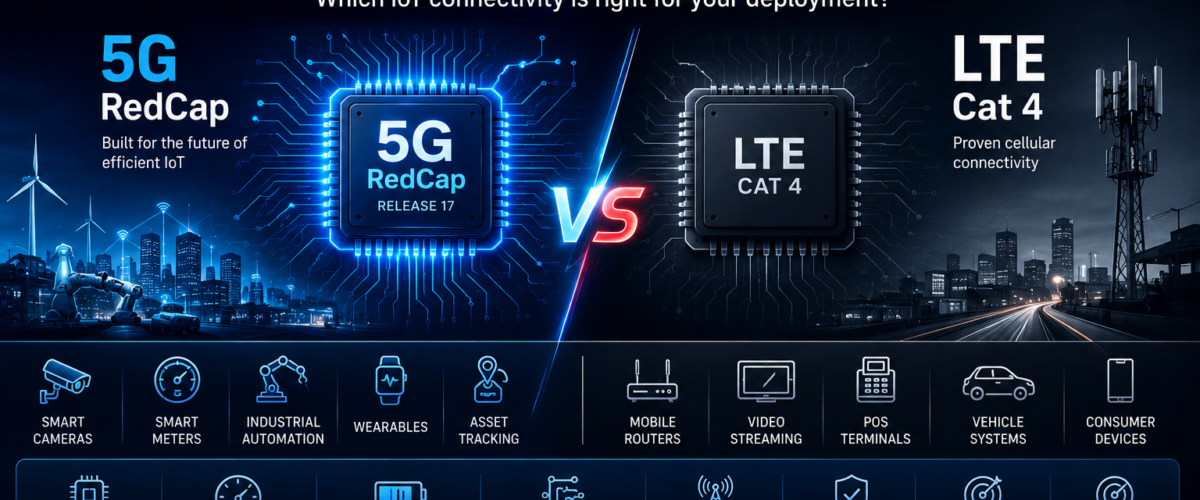
RedCap vs LTE Cat-4: When to Specify Which
LTE Cat-4 has served industrial IoT well for a decade. 5G RedCap is its successor – but not yet its replacement everywhere. Here is the practical decision framework for engineers and buyers specifying hardware today.
This is not a question about which technology is better. RedCap is technically superior to LTE Cat-4 in almost every dimension that matters for 5G-era deployments. The question is whether that technical superiority translates into the right procurement decision for your specific deployment, timeline, and geography right now.
The honest answer is that both technologies have a place in UK IoT hardware specifications in 2026. Knowing which one to reach for depends on four things: device lifecycle, deployment location, throughput requirement, and budget. This guide works through each of them.
The baseline comparison
| Factor | LTE Cat-4 | 5G RedCap |
|---|---|---|
| Peak downlink | 150 Mbps | 150 Mbps (same) |
| Peak uplink | 50 Mbps | 50 Mbps (same) |
| Network generation | 4G LTE | 5G SA |
| UK coverage | Near universal | Urban / major business parks only (2026) |
| Network slicing | No | Yes |
| Enhanced positioning | No | Yes |
| Long-term operator investment | Declining – 4G being deprioritised | Active – 5G SA is the strategic network |
| Module cost (mid-2026) | ~$10-15 | $30-50 (falling to $15-25 by late 2026) |
| Module availability | Broad – mature ecosystem | Growing – 17+ manufacturers now |
| LTE fallback | N/A | Supported – most modules fall back to Cat-4 |
| Sunset risk | Medium-term – operators prioritising 5G SA | None – built on the strategic network |
One thing worth noting from that table: the throughput numbers are identical. RedCap at Release 17 delivers the same 150 Mbps downlink and 50 Mbps uplink as LTE Cat-4. The advantage of RedCap is not speed – it is the network it runs on, and what that network enables: slicing, positioning, long-term operator commitment, and the absence of sunset risk.
The four questions that drive the decision
1. What is the device lifecycle?
This is the most important single factor. If your device will be in the field for three years or less, Cat-4 is fine. The 4G network is not going away in three years. If your device will be in the field for seven to ten years, the 4G sunset question becomes real. UK operators are investing heavily in 5G SA infrastructure. They are not investing in 4G at the same rate. The 2G and 3G sunsets forced expensive replacement cycles for millions of IoT devices. A device specced on Cat-4 today and deployed for a decade is making a bet that 4G remains well-maintained through the mid-2030s. That is not an unreasonable bet, but it is a bet. RedCap removes it.
2. Where is the device deployed?
5G RedCap requires 5G Standalone core coverage. In the UK in 2026, that means major city centres and key business parks. EE has the broadest 5G SA footprint. Vodafone is live. Three is testing. O2 and VMO2 are building. In secondary towns, industrial estates, and rural areas, 5G SA coverage is a 2026-2028 story at the optimistic end. If your deployment is rural or semi-rural, Cat-4 is the practical choice today – RedCap modules support LTE Cat-4 fallback, but you are paying for a 5G device that runs on 4G for most of its life. Check the UK network coverage position against your target deployment locations before committing.
The exception: private 5G networks. If you control the infrastructure, you can deploy 5G SA wherever you need it. Private campus networks are where UK RedCap commercial activity is most immediate, precisely because they bypass the public network coverage constraint entirely.
3. What throughput does the application actually need?
If the application needs more than 50 Mbps consistent uplink – high-resolution surveillance video, industrial inspection cameras, dense telemetry aggregation – neither Cat-4 nor RedCap is your answer; you need full 5G NR. If the application needs less than 1 Mbps, NB-IoT or LTE-M is more appropriate and considerably cheaper. Cat-4 and RedCap both target the middle ground. The application-level throughput requirement does not differentiate them on paper. What does differentiate them is what happens when the network evolves: on a 5G SA network, RedCap can use dedicated network slices with guaranteed QoS. Cat-4 cannot, regardless of how mature the application is.
4. What is the budget and procurement cycle?
RedCap modules are currently running at $30 to $50 per unit. Cat-4 modules are $10 to $15. That is a real difference at volume. The RedCap premium is expected to fall to $15 to $25 by late 2026 as production scales – but it is the current reality, not the future projection, that governs a purchase decision being made now. If budget is tight and the deployment timeline is this year, Cat-4 remains the economically rational choice for many applications. If procurement is for a 2027 deployment, the cost gap narrows considerably and the lifecycle argument tilts more firmly toward RedCap.
The decision in plain terms
- Device lifecycle is three years or less
- Deployment is rural, semi-rural, or outside 5G SA coverage
- Budget is constrained and deployment is this year
- Replacing existing Cat-4 hardware like-for-like
- Application is simple telemetry with no video or high-throughput requirement
- You need maximum module choice from the most mature ecosystem
- Device lifecycle is five years or more
- Deployment is in major UK urban areas or a private 5G campus
- Network slicing or guaranteed QoS is a requirement
- Hardware is being designed now for a 2027+ launch
- Eliminating LTE sunset risk is a design objective
- Application involves video, surveillance, or higher-throughput data
- The deployment spans countries where RedCap is already commercially live
The hybrid answer: most RedCap modules support LTE Cat-4 fallback. A device designed around a RedCap module can operate on Cat-4 where 5G SA is unavailable, and automatically use RedCap where it is. For national deployments with mixed urban and rural sites, this is often the practical resolution – you pay the RedCap premium, but you get universal coverage today and 5G capability wherever the network supports it, with the full fleet future-proofed as SA coverage expands.
What about eRedCap?
If your application sits at the Cat-1 or Cat-1bis performance level – basic telemetry, POS terminals, fleet tracking – there is a third option emerging. eRedCap (3GPP Release 18) targets exactly that device class, with 10 Mbps peak throughput on 5G SA infrastructure. Chipsets are arriving through 2026 and 2027, with volume module availability from 2027-2028. If you are designing hardware today for a 2027 or 2028 deployment and your throughput requirement is modest, eRedCap belongs in the evaluation alongside Cat-4 and RedCap.
The hardware available now
The RedCap hardware guide covers the current module and router landscape. For UK industrial IoT applications, Teltonika’s RUT271 is the most relevant commercial RedCap router currently available – a known product in a known supply chain, which matters as much as the spec sheet for most procurement teams. For Cat-4, the Teltonika RUT240 and RUT241 remain the workhorse products across the UK industrial IoT market.
Deploy Cat-4 where it works and makes economic sense today. Design new hardware for RedCap where the lifecycle and location justify it. Use the fallback capability of RedCap modules to cover both cases on national deployments. And if your procurement timeline stretches into 2027, get eRedCap on your evaluation list before the chipsets arrive and the ecosystem locks in. The May 2026 UK status update has the current coverage picture by operator.
Leave a Reply