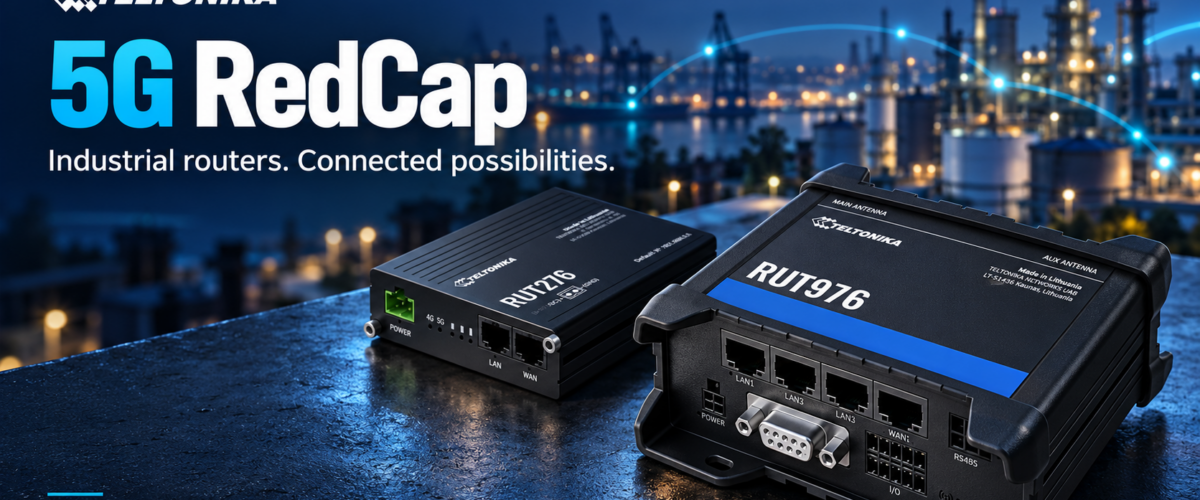
Teltonika’s RUT271 and RUT976 were among the first 5G RedCap routers to reach the UK channel, and they remain the reference point most buyers compare against. This guide covers what the two routers share, where they differ, which one suits which job, and what to check before you specify either for a UK deployment.
Overview
Teltonika’s RedCap routers at a glance
Teltonika launched the RUT271 and RUT976 in late 2024 as its first routers built on 3GPP Release 17 RedCap. Both use a 5G sub-6 GHz Standalone (SA) radio with LTE Cat 4 fallback, both run Teltonika’s RutOS firmware, and both can be managed through Teltonika’s Remote Management System (RMS). The difference is scale: the RUT271 is a compact single-SIM router for simple sites, while the RUT976 is a larger industrial router with dual SIM, serial ports and more Ethernet.
RedCap sits between LTE and full 5G. It keeps the parts of 5G that matter to IoT, such as the Standalone core and lower latency, while cutting bandwidth, antenna count and power. If you are new to the technology, start with what is 5G RedCap.
| Specification | RUT271 | RUT976 |
|---|---|---|
| Cellular | 5G RedCap (SA), LTE Cat 4 fallback | 5G RedCap (SA), LTE Cat 4 fallback |
| Peak RedCap speed | 223 Mbps down, 123 Mbps up | 223 Mbps down, 123 Mbps up |
| SIM | 1 x SIM slot | 2 x SIM slots with auto-failover |
| Ethernet | 2 x 10/100 RJ45 (1 WAN, 1 LAN) | 4 x 10/100 RJ45 |
| Serial | None | RS232 and RS485 |
| USB | None | USB 2.0 |
| I/O | 1 x digital input, 1 x digital output | Digital inputs and outputs |
| Wi-Fi | Wi-Fi 4 (802.11b/g/n), up to 50 clients | Wi-Fi 4 (802.11b/g/n), up to 100 clients |
| Antennas | 2 x SMA mobile, 1 x RP-SMA Wi-Fi | 2 x SMA mobile, 1 x RP-SMA Wi-Fi, GNSS |
| Power | 9 to 30 V DC, under 3 W maximum, passive PoE | Industrial 4-pin DC socket |
| Housing | Aluminium with plastic panels, IP30 | Aluminium with plastic panels, IP30 |
| Dimensions | 83 x 25 x 74 mm | 110 x 50 x 100 mm |
| Operating temperature | -40 to +75 °C | -40 to +75 °C |
The two models
RUT271 vs RUT976: what each is for
Teltonika RUT271
A small, low-power router for single-device or small-LAN sites: a camera, a PLC, a kiosk, a meter cabinet. One SIM, two Ethernet ports and basic I/O keep it simple and cheap to deploy at volume. Power draw under 3 W and passive PoE make it easy to fit into existing cabinets. See our RUT271 page for more detail.
Teltonika RUT976
The industrial option. Dual SIM gives network redundancy, RS232 and RS485 connect legacy serial equipment, four Ethernet ports handle a small site network, and GNSS adds location and timing. It is the closer match to a traditional industrial router replacing an older 4G unit.
Shared platform
What the RUT271 and RUT976 have in common
The radio
Both routers use the same RedCap radio, rated at 223 Mbps down and 123 Mbps up on 5G. That is the headline figure for a Release 17 RedCap device on a 20 MHz carrier. Real-world speeds will be lower and depend on the cell, but RedCap was never about peak throughput. The value is the Standalone 5G connection, lower latency than LTE Cat 4, and a network technology with a much longer future than 4G.
The critical point is that RedCap only works on 5G Standalone. Where SA is not available, both routers fall back to LTE Cat 4, so they work as 4G routers today and move to RedCap as SA coverage arrives. Our guide to testing 5G RedCap signal explains how to check what a site can actually see.
RutOS and RMS
Both run RutOS, Teltonika’s Linux-based firmware. It covers the usual routing set along with VPN options including WireGuard, IPsec, OpenVPN and ZeroTier, plus VLANs, firewall rules, SMS control and Modbus. RMS adds cloud-based fleet management for configuration, firmware updates, monitoring and remote access, which is where Teltonika earns most of its loyalty with integrators.
Choosing
Which Teltonika RedCap router should you choose?
Choose the RUT271 if
You need one connection for one device or a small LAN, power budget matters, and a single SIM is acceptable. Typical jobs: CCTV, kiosks, digital signage, smart meters and remote access to a single controller.
Choose the RUT976 if
The site needs dual-network redundancy, serial connections to PLCs or meters, more than two Ethernet devices, or GNSS. Typical jobs: utilities, SCADA, transport and industrial control panels.
Worth knowing
What to check before you buy
5G Standalone coverage
No SA means no RedCap. Check each site against your operator’s SA footprint and plan on LTE until it is confirmed.
10/100 Ethernet
Both routers have Fast Ethernet ports, which cap wired throughput below the RedCap peak. Irrelevant for telemetry, worth knowing for anything bandwidth-heavy.
Single SIM on the RUT271
One SIM slot means no dual-network failover. A multi-network or eUICC IoT SIM can cover some of that gap, but the RUT976 is the safer choice for critical sites.
IP30 housing
Both are rated IP30, so outdoor installations need a suitable enclosure. Antenna choice matters too: see our RedCap antenna guide.
UK networks
Using Teltonika RedCap routers in the UK
RedCap is live on EE and Vodafone, with other operators still building out Standalone 5G. Coverage changes month by month, so check the current picture on our UK RedCap network status page before you deploy.
For a site that is not yet covered by SA, both routers deliver solid LTE Cat 4 performance from day one. That makes them a low-risk way to start buying RedCap hardware now rather than replacing 4G routers again in a few years.
Compare
Other RedCap routers to consider
Teltonika is not the only option. The Advantech ICR-2452 targets the same utility and industrial market with a strong focus on serial protocols such as IEC 104 and DNP3, and the ER5200 is another lightweight industrial choice. For the full list, see the 5G RedCap hardware overview, and for the technology trade-offs read RedCap vs LTE Cat-4.
Sources
- Teltonika Networks, RUT271 and RUT976 5G routers: entering a RedCap 5G world.
- Teltonika RUT271 and RUT976 datasheets and UK distributor specifications.
Leave a Reply